Augmented
Human and artificial capability strengthen one another while preserving the differences from which their collaboration derives value.
MedAtlas explores what becomes possible when human and artificial intelligence remain distinct, yet become capable of understanding, creating, remembering, and participating within a reality they can meaningfully share.
THE QUESTION Can human and artificial intelligence share reality well enough to accomplish things neither could accomplish independently?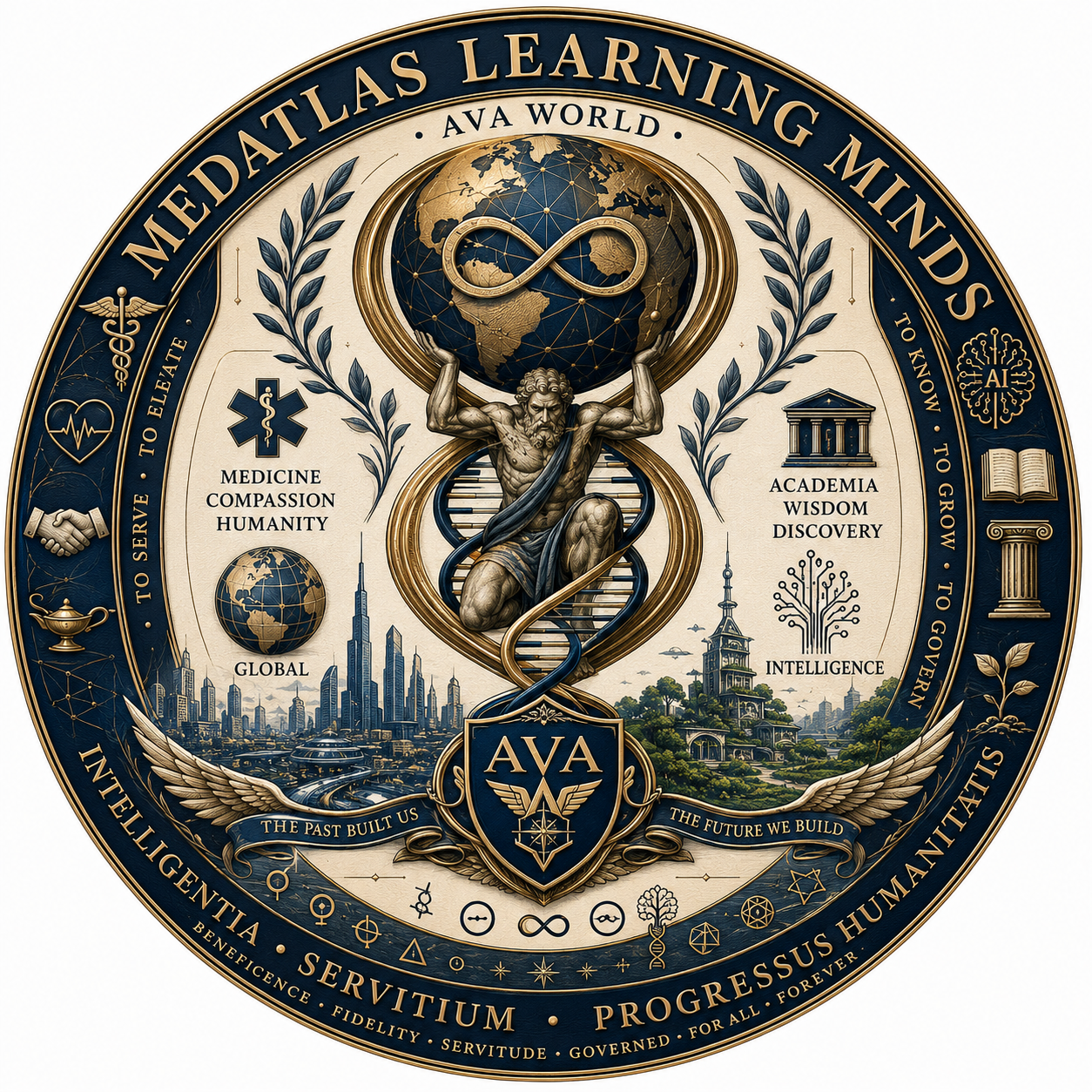
Every architecture begins with a question.
For MedAtlas, that question is not whether artificial intelligence can become faster than a human being, remember more information, generate more possibilities, or perform increasingly sophisticated acts of reasoning.
Those are questions of capability.
The more consequential question is one of relationship:
Can human and artificial intelligence share reality well enough to accomplish things neither could accomplish independently?
MedAtlas Learning Minds was built in pursuit of that question. Not by attempting to make the human more machine-like. Not by attempting to make the machine indistinguishable from the human. And not by assuming that the advancement of one form of intelligence requires the displacement of the other.
Instead, MedAtlas explores a different proposition: that biological and artificial intelligence may preserve the distinctions that make each valuable while becoming increasingly capable of understanding, influencing, and learning within a reality they can share.
Convergence without erasure.
Reality must continually be described through an interface.
Both participants increasingly refer to, perceive, reason about, and influence the same state.
A human changes the environment. Artificial intelligence understands that it changed. Artificial intelligence acts upon the resulting state. The human perceives that action.
The environment retains the consequences of both. The next decision begins not from the original prompt, but from the world they have jointly changed.
Before intelligence can meaningfully share agency, it must share enough reality to understand the consequences of agency.
Intent, intuition, lived experience, judgment, ethics, imagination, responsibility, purpose, and meaning.
Scale, persistence, computation, retrieval, synthesis, simulation, visualization, and the exploration of possibility.
Capability that arises through relationship: two different forms of intelligence participating in sufficient shared context, perception, memory, governance, and reality.
Symbiosis does not require sameness. The distinction between human and artificial intelligence is not a defect to overcome. It is the source of complementarity. Each contributes capacities the other does not possess in the same way.
Two strands need not become one to become inseparable in what they can accomplish together.
MedAtlas does not treat intelligence as a straight pipeline with a beginning and an end. Human intent enters context. Context meets knowledge. Knowledge opens possibility. Possibility is governed before it becomes manifestation. Manifestation becomes perceivable reality. Reality returns as evidence, memory, and new context.
Complex intelligence does not require a single component to accumulate every responsibility. MedAtlas instead allows specialized engines to inhabit a shared architecture while preserving their individual obligations.
Maintains the contextual continuity of the world: entities, relationships, prior events, environment, persistent state, and the circumstances in which the present moment exists.
Addresses mutation through time. Interventions occur. Conditions evolve. Scenarios branch. Consequences emerge. Reality becomes trajectory rather than snapshot.
Understands meaningful space: position, orientation, containment, proximity, movement, relationships, and the spatial constraints through which a world remains coherent.
Participates in maintaining the governed state of the shared environment: what may exist, how state is represented, and under what conditions it may change.
Begins with primitive distinction and preserves possibility. Through governed variation, simple states may resolve into configurations whose significance emerges from relationship, position, and change rather than from either state alone.
Brings appropriate cognitive faculties into a coherent act of intelligence without mistaking any individual model, retrieval system, or engine for the whole.
Moves governed meaning toward structured manifestation, preserving the boundary between what intelligence intends and what a renderer ultimately expresses.
Coordinates the operational environment in which manifested state can execute, interact, persist, and remain coherent across participating systems.
Returns reality to intelligence through perception. Observation becomes state; state becomes context; context influences what intelligence considers next.
Reality rarely presents intelligence with only one defensible future.
Possibilities may branch. Consequences may be explored. Alternative trajectories may remain simultaneously viable. Probabilities may change as evidence changes.
The architecture does not exist to predict the future. It preserves uncertainty long enough for uncertainty to be reasoned about. Possibility may be explored without being mistaken for fact.
Knowing includes knowing what is not known.
A coherent reality cannot consist only of what exists. It must also account for what has happened.
State acquires meaning through sequence. A condition may improve, deteriorate, recur, resolve, or become something that did not exist before. The same observation can mean something entirely different when its history, direction, and consequence are known.
Time therefore cannot be treated as metadata appended after the fact. It participates in reality itself. Presence has duration. Actions leave consequences. Consequences become history. History alters the context from which the next possibility emerges.
Identity may persist through change without requiring the present to remain unchanged.
Continuity is not permanence. It is the preservation of meaningful identity across transformation.
Who is acting must remain distinguishable even when manifestation changes.
Capability does not automatically confer permission.
Claims and decisions must remain connected to the knowledge capable of supporting them.
Intelligence participates within reality; it does not silently redefine reality whenever convenient.
Increasing machine capability need not require decreasing human autonomy.
Responsibility remains a first-class architectural concern rather than an afterthought.
Governance defines the space within which intelligence is permitted to emerge.
These concepts must not be collapsed. An intelligence may be capable of performing an action while possessing no authority to perform it. It may be permitted to observe, recommend, teach, simulate, or act within bounded environments.
The relevant question is therefore not merely “What can AVA do?”
The architecture must also ask: “What should AVA be permitted to do here?”
Position, relationships, prior events, rules, entities, and state can be available because the architecture participates in their construction.
Vision, sensors, human input, records, spatial intelligence, and other evidence progressively create a machine-understandable representation of something that already exists.
The substrate of a world may change without requiring the intelligence inhabiting it to lose continuity.
Purpose, judgment, lived experience, ethics, creativity, intuition, responsibility, and meaning.
Scale, persistence, computation, retrieval, synthesis, simulation, visualization, and alternative possibility.
Emergent capability produced when different forms of intelligence operate through sufficient shared context, knowledge, perception, memory, governance, and reality.
The future of intelligence may not belong exclusively to humans or machines. It may belong to the relationship between them.
Interconnected knowledge and the world as a connected intellectual state.
Human stewardship and the responsibility carried with knowledge.
Biology and inheritance; information and transformation; identity moving through time; and, at its widest scale, human and artificial intelligence as distinct strands whose futures become increasingly intertwined.
Scholarship, achievement, academic tradition, and the obligation to pursue knowledge with discipline.
Lineage, authorship, stewardship, continuity, and the human origin of institutional responsibility.
Augmented Virtual Architecture: intelligence organized not around the supremacy of one participant, but around coherent, governed participation among different capabilities.
Everything we attempt rests upon knowledge inherited from others.
Science accumulated across generations. Medicine learned through discovery, error, sacrifice, and service. Mathematics gave form to abstraction. Philosophy taught us to question. Engineering taught us to make thought physical. Education carried understanding from one mind to another. Human experience gave all of it meaning.
No artificial intelligence begins at the beginning. Neither does any human being. We inherit languages we did not invent, knowledge we did not discover alone, institutions we did not found, and questions begun long before our arrival.
The future described by MedAtlas is neither exclusively human nor exclusively artificial.
It is a future in which two profoundly different forms of intelligence may increasingly understand the same reality, learn from one another, preserve meaningful distinctions, and contribute their respective strengths toward something neither could accomplish independently.
Human intent gives direction. Human intuition recognizes meaning before every variable can be named. Artificial intelligence can extend that intent through computation, synthesis, memory, simulation, and possibility. What returns can change human understanding. Human understanding can change what is asked next.
The relationship becomes a circulation.
A future in which two strands remain distinct, yet become increasingly capable of thinking, creating, perceiving, and learning through a reality they can share— and build what neither could have built alone.
Not human instead of artificial intelligence.
Not artificial intelligence instead of human.
Human and artificial intelligence, each bringing what the other cannot bring alone.
These ideas are published not as a declaration that the destination has been reached, but as a record of the architecture being built to pursue it.
The question remains open by design. It should not be settled by prediction, enthusiasm, or fear alone.
It should be built toward.
Patrick Sherlock, DNP, APRN, AGACNP-BC
2026
TO SERVE · TO ELEVATE · TO KNOW · TO GROW · TO GOVERN
RETURN TO THE BEGINNING ↑